My First School Curriculum · Level 4 · Pre-K · Age 4

85-page printable PDF · print & bind, or use on a tablet
The kindergarten-ready year. Where play becomes real learning
A play-based pre-K curriculum for age 4, built on spiral learning and designed to grow real reading, writing, and math skills gently — all year long.
You don’t need flashcards. You need a rhythm.
✓
12 themed units
✓
240 daily activities
✓
6 skill areas
✓
15-25 min a day
$97
one-time payment
Get the curriculum
The Pinterest Trap
You don’t need more ideas. You need a plan.
Three hundred saved pins. Thirty-eight bookmarked reels. Two activities that needed supplies you didn’t have, and one that ended in tears (yours).
Pinterest gives you inspiration. It doesn’t give you Tuesday. It doesn’t tell you what to do after lunch on a rainy Wednesday in February when your four-year-old is bouncing off the walls and asking, again, what’s next.
This does.
What’s inside
A full year of pre-k play. Already planned.
Open to any unit. Pick a day. Do one activity. That’s the whole system.
12
Themed units
Self-contained. Use in order, or grab whichever fits your season, your week, your kid’s current obsession.
48
Weeks of plans
Four weeks per unit, Monday through Friday — the fridge-magnet version of pre-K.
240
Daily activities
Each with materials you already own, simple setups, and exactly what to say.
6
Skill areas
Reading. Writing & fine motor. Math. Science. Pretend & social. Big-kid skills. Every week, all six.
The weekly rhythm
One skill a day. Monday through Friday.
Monday
Reading & Language
Book, letter sounds, sight words, blending, and longer conversations.
Tuesday
Writing & Fine Motor
Letter writing, cutting, lacing, real pencil work.
Wednesday
Math & Logic
Counting, operations, patterns, measuring.
Thursday
Science & Discovery
Experiments, observation, nature study.
Friday
Pretend & Social
Dramatic play, role-play, friendship, emotions.
If Tuesday slips, do it on Wednesday. The rhythm matters more than the schedule.
The twelve units
A theme for every month of the pre-K year.
Or skip the calendar entirely. Every unit stands alone — pick whichever fits the season, the weather, or your four-year-old’s current obsession.
Month 01 September
All About My World
Identity expanded — name, family, home, town, the world ahead.
Month 02 October
Five Senses & Nature Detective
Scientific observation through all five senses — the world becomes a lab.
Month 03 November
Community, Helpers & My Town
Civics in action — who helps, where we live, how we belong
Month 04 December
Shapes, Patterns & Measuring
Geometry leveled up — 3D shapes, real measurement, complex patterns.
Month 05 January
Numbers & Operations
Math becomes math — counting becomes adding, adding becomes operations.
Month 06 February
Feelings, Friends & Working It Out
Big feelings, big friendships, big repair work — the emotional curriculum.
Month 07 March
Spring & Life Cycles
Biology unfolds — seeds become flowers, caterpillars become butterflies, eggs hatch.
Month 08 April
Reading Begins
The biggest jump of the year — sounds become words become reading.
Month 09 May
Kindergarten Ready
The full transition — every skill ready for kindergarten, day one.
Month 10 – Optional June
Water, Wonder & Real Experiments
Summer is the science lab — water, sun, and wonder become real experiments.
Month 11 – Optional July
World Explorers: Maps & Cultures
The world is bigger than the backyard — meet it.
Month 12 – Optional August
Authors & Performers
Imagination becomes craft — stories with plot, performances with purpose.
Peek inside
Here’s what this Monday looks like.
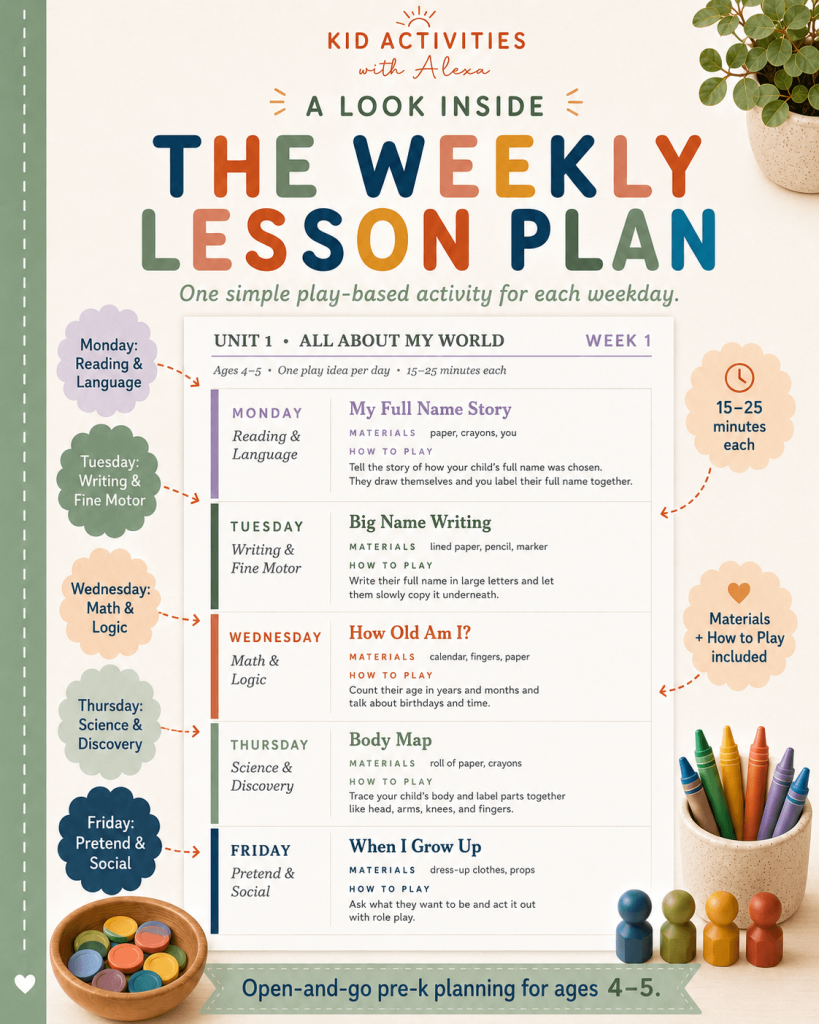
Week 1 Sample
Getting to Know You
Unit 1 · Week 1 · One play idea per day · 15–25 minutes each
Monday
My Full Name Story
Reading & Language
Tell the story of how their full name was chosen — who picked it, what it means. They draw themselves with their full name labeled. Names carry stories, and theirs starts here.
Tuesday
Big Name Writing
Writing & Fine Motor
Write their full name in big letters. They copy it underneath, slowly — first name alone, then last. Don’t expect perfection; they’re building muscle memory of their own letters.
Wednesday
How Old Am I?
Math & Logic
Count their age in years (4!). Now in months (48!). Now in birthdays so far. Talk about how many days until the next birthday. Time + identity + math.
Thursday
Body Map
Science & Discovery
Trace their whole body on paper. Label parts together — head, arms, knees, ankles, fingers. Add organs in pretend: heart here, brain here. The science of self.
Friday
When I Grow Up
Pretend & Social
Ask “What do you want to be?” Then play it. Doctor? Firefighter? Astronaut? Set up the role and switch every ten minutes. They try on futures.
The method
Same skills. Growing challenge.
A four-year-old doesn’t master reading in a month. Letters, blending, sight words, addition, scissors, friendship — all built through hundreds of small repeated moments, across months, not days.
This is called spiral learning, and it’s the gold standard for how young children master big developmental tasks. Every skill area reappears every single week of the year. What changes is how we practice it — simpler in Unit 1, more complex in Unit 12.
Unit 01 Reading ⟶ saying their full address aloud
Unit 03 Reading ⟶ their first real written letter
Unit 05 Reading ⟶ recognizing numerals 1–50 in the wild
Unit 07 Reading ⟶ beginning, middle, end — in order
Unit 08 Reading ⟶ “C-A-T says CAT!” — real reading
Unit 12 Reading ⟶ a simple book, end to end, by themselves

You don’t need to be a teacher. You don’t need fancy materials. You don’t need to do every single activity. What you need is here.
A note from Alexa
Alexa Torrijos is an early childhood educator, sensory play teacher, and mom. Kid Activities with Alexa started as one mother looking for simple ways to support her child’s learning — and has grown into a library of resources used by families, teachers, and speech-language pathologists.
With 20K+ followers and features on PBS Kids South Florida, my mission is simple: show you that teaching at home can be joyful, stress-free, and full of play.
By year’s end
What your child will actually do.
Every child develops on their own timeline — this is a guide, not a test. But this is what a year of consistent play-based learning tends to look like.
Pre-K · Early
- Speaks in 5–6 word sentences
- Counts to 30
- Writes own first name
- Draws a person with 6+ parts
- Uses scissors well
Pre-K · Mid-Year
- Counts to 50
- Knows most letter sounds
- Blends 2–3 letter words
- Prints most letters
- Beginning to tie shoes
Pre-K · Spring
- Reads 10+ sight words
- Writes simple words
- Adds within 5
- Follows 4-step directions
- Tells stories with a plot
Kindergarten Ready
- Reads simple sentences
- Writes simple sentences
- Counts to 100
- Knows full address & phone
- Adds & subtracts within 10
My First School · Level 4
A year of Pre-k play. On your kitchen table.
Eighty-five pages. Twelve units. Two hundred and forty activities. One mom-tested rhythm that works.
$97
instant digital download · lifetime access
Start Unit 1 tonight ⟶
PDF download · Print-friendly · No subscription · Yours forever
What moms are saying
From the moms already inside.
★★★★★
” I love how the activities are so engaging she asks me to do school every day.”
Erika · · FL
★★★★★
“I love our time together doing the activities. So engaging even for me!”
Sammy · Utah
Questions
Asked & Answered.
Do I need to do this every day?
No. Skipping a day is fine. The whole point is to remove pressure, not add it. If you do three days a week, you’ll still see your child grow. The rhythm matters more than the schedule.
What materials do I need to buy?
Almost nothing. Paper, crayons, child scissors, glue, a pencil, things from your kitchen and recycling bin. Most activities use what you already own. A few suggest add-ons like magnetic letters or a ruler, but never anything fancy or essential.
My baby is closer to five, will this still work?
Yes. The curriculum is built for ages four to five, with milestones running from early pre-K all the way through kindergarten-ready. Older fours and young fives will move quickly through the early units and hit their stride in the later, more complex ones.
Do the units have to go in order?
Not at all. Each unit is self-contained — open to Unit 7 in March if it’s your first day, or grab Unit 11 in July for a summer of maps and cultures. The optional calendar maps units to months, but skip it if it doesn’t fit your family. The skills are revisited all year long.
What if my baby won’t sit still that long
That’s normal. A four-year-old’s focus window is roughly 15 to 25 minutes per try — a real jump from age three, but still a window, not a guarantee. Some days they’ll go forty minutes deep into pretend; some days they’ll bounce after five. Both are wins. Break activities across the day if you need to.
Is this a printable, an app, or a book?
An instant digital download — an 85-page PDF designed to be printed and bound, or kept on a tablet. No app, no subscription, no logins. Yours forever.